"A liberal hand. The hearts of old gave hands,/ But our new heraldry is hands, not hearts."
~ Othello, Othello III.iv.40-41
Okay, food for thought: why is it such a big deal that a woman cheats on her husband, but no one cares when a man has approximately 12 mistresses?
Think about it. Othello is apparently so mad that he is going to violently kill Desdemona for cheating on him, but supposedly he also is screwing Iago's wife? (Okay, that is not proven. But if it was true, who would do anything? Iago is trying to get revenge, but Othello would not be formally punished.) What the heck?? I think I just don't understand what constitutes a man's right to murder a woman who cheats while he is doing the exact same thing and no one says anything. And it still applies today to an extent - if a girl cheats on a guy or sleeps around a lot (or in some cases (especially high school) even if she only has sex once), she is automatically a dirty little whore. But if a guy cheats or sleeps around, DON'T WORRY! IT'S OKAY! He is only satisfying his overactive sex drive and I guess that is perfectly acceptable in this society. I'm not saying that women should go out and cheat and not be punished for it, but I'm just trying to convey that if you are going to call a girl a slut for sleeping around, you might as well acknowledge her man-ho counterpart. I am only striving for equality! Also, if a girl wants to be - ahem - expressive with her assets, then who are you to judge her? Just saying.
Monday, January 30, 2012

Suspense - Drama Blog 2 (Othello)
"Blest fig's-end! The wine she drinks is made of grapes. If she had been blest, she would never have loved the Moor."
~ Iago, Othello II.i.238-239
He can't even tell his best friend the truth.
4. How is dramatic suspense created? Contrast the amount of information possessed by the audience as the play proceeds with the knowledge that various individual characters have: what is the effect of such a contrast?
So basically, all the suspense in Othello is created by knowledge of information: who has it and when they will get it. Iago's scheming and true motives/nature are always known by him and the audience. Suspense is created on a level when the audience first knows of Iago's plan, then it drastically builds as we start to see parts of the plan unraveling and the undone deeds getting more and more complex and imminent. He gradually reveals information about what he will do next (usually at the end of an act or scene), which keeps us at the edge of our seats. The second part to the suspense is the other characters onstage. At this point, no one but Iago knows the extent of his plot (Roderigo knows a little, but not a sufficient amount). The audience then wonders who will find out first, when, and if the protagonists will find out before they react poorly to the lies Iago has planted.
~ Iago, Othello II.i.238-239
He can't even tell his best friend the truth.
4. How is dramatic suspense created? Contrast the amount of information possessed by the audience as the play proceeds with the knowledge that various individual characters have: what is the effect of such a contrast?
So basically, all the suspense in Othello is created by knowledge of information: who has it and when they will get it. Iago's scheming and true motives/nature are always known by him and the audience. Suspense is created on a level when the audience first knows of Iago's plan, then it drastically builds as we start to see parts of the plan unraveling and the undone deeds getting more and more complex and imminent. He gradually reveals information about what he will do next (usually at the end of an act or scene), which keeps us at the edge of our seats. The second part to the suspense is the other characters onstage. At this point, no one but Iago knows the extent of his plot (Roderigo knows a little, but not a sufficient amount). The audience then wonders who will find out first, when, and if the protagonists will find out before they react poorly to the lies Iago has planted.
Character Studies - Drama (Week 1) (Othello)
"Not I, I must be found./ My parts, my title, and my perfect soul/ Shall manifest me rightly. Is it they?"
~ Othello, Othello I.ii.30-32
Well, since this is my first blog, let's start off easy - characters!
3. Identify the protagonists and antagonists. Are there any foil characters? What dramatic functions are served by the various minor characters? Do they shed light on the actions or motives of the major characters? Do they advance the plot by eliciting actions by others? Do they embody ideas or feelings that illuminate the major characters or the movement of the plot?
Holy crap! That was a little more involved than I anticipated. We'll only tackle the necessities.
PROTAGONIST: Othello. He's the strong, attractive, classic battle hero little girls dream about in their fairy tales. He's well-mannered, level-headed, and passionately in love with his wife, Desdemona - he's a textbook good-guy. However, as we leave Act 3, we already witness some potential tragic flaws. He's easily manipulated by that sneaky devil Iago (don't worry, we will analyze him next), so he is jealous and definitely can get a temper when provoked long enough.
ANTAGONIST: Iago. What a piece of work! There's no doubt that he is smart - he knows how to manipulate everybody to get whatever he wants when he wants it. DRAMATIC IRONY: While all the characters onstage are drooling over how honest and good Iago is, it turns out that he is a lying, scheming failure of a person, and I'm really questioning whether he even has a soul. He has that sickening quality of being ridiculously nice in public, but to those of us who have known bad people, we all sit back and gag while he makes some huge display of his affections toward the men he is willing to kill because they have supposedly "wronged" him in some way. Basically, he sucks.
FOIL CHARACTERS: Iago and Cassio. No need to describe Iago again. Cassio is completely the opposite. He is kind and loyal, and I think he likes Desdemona - which makes him an even better person because he always helped Othello court her and he stood by his friends when they had something he wanted. He doesn't let jealousy get the best of him (unlike Iago who is consumed by it), and he wants the best for other people.
As for the various minor characters, I'm not exactly sure at this point? The only one I truly remember is the Clown, who is only there for comic relief (he's punny.) in the midst of the web of deception and jealousy and bluh.
~ Othello, Othello I.ii.30-32
Well, since this is my first blog, let's start off easy - characters!
3. Identify the protagonists and antagonists. Are there any foil characters? What dramatic functions are served by the various minor characters? Do they shed light on the actions or motives of the major characters? Do they advance the plot by eliciting actions by others? Do they embody ideas or feelings that illuminate the major characters or the movement of the plot?
Holy crap! That was a little more involved than I anticipated. We'll only tackle the necessities.
PROTAGONIST: Othello. He's the strong, attractive, classic battle hero little girls dream about in their fairy tales. He's well-mannered, level-headed, and passionately in love with his wife, Desdemona - he's a textbook good-guy. However, as we leave Act 3, we already witness some potential tragic flaws. He's easily manipulated by that sneaky devil Iago (don't worry, we will analyze him next), so he is jealous and definitely can get a temper when provoked long enough.
ANTAGONIST: Iago. What a piece of work! There's no doubt that he is smart - he knows how to manipulate everybody to get whatever he wants when he wants it. DRAMATIC IRONY: While all the characters onstage are drooling over how honest and good Iago is, it turns out that he is a lying, scheming failure of a person, and I'm really questioning whether he even has a soul. He has that sickening quality of being ridiculously nice in public, but to those of us who have known bad people, we all sit back and gag while he makes some huge display of his affections toward the men he is willing to kill because they have supposedly "wronged" him in some way. Basically, he sucks.
FOIL CHARACTERS: Iago and Cassio. No need to describe Iago again. Cassio is completely the opposite. He is kind and loyal, and I think he likes Desdemona - which makes him an even better person because he always helped Othello court her and he stood by his friends when they had something he wanted. He doesn't let jealousy get the best of him (unlike Iago who is consumed by it), and he wants the best for other people.
As for the various minor characters, I'm not exactly sure at this point? The only one I truly remember is the Clown, who is only there for comic relief (he's punny.) in the midst of the web of deception and jealousy and bluh.
Thursday, December 15, 2011
Sarcasm at Its Best - Short Story Blog 4 (You're Ugly, Too)
" 'I knew a dog who could do that,' said Zoe, with her mouth full."
~ Lorrie Moore, You're Ugly, Too
First of all, I would just like to say that I have used this joke twice since I read this story. And that dry humor is probably my favorite. I enjoyed Zoe's sense of humor and sarcasm throughout the story. I think the reasons for her jokes is really depressing though - she's so insecure about herself that she pushes people away before she can screw it up herself. I mean, don't get me wrong, it's entertaining, but just a little sad. Her rough exterior is completely different from her fragile self-image which could shatter at any given moment. It's a little ridiculous that she would even think other people care about her appearances at all - once someone's horrible personality is revealed, looks are kind of out of the question. It makes you think about how her insecurities are completely deluding her perception of how people receive her humor.
~ Lorrie Moore, You're Ugly, Too
First of all, I would just like to say that I have used this joke twice since I read this story. And that dry humor is probably my favorite. I enjoyed Zoe's sense of humor and sarcasm throughout the story. I think the reasons for her jokes is really depressing though - she's so insecure about herself that she pushes people away before she can screw it up herself. I mean, don't get me wrong, it's entertaining, but just a little sad. Her rough exterior is completely different from her fragile self-image which could shatter at any given moment. It's a little ridiculous that she would even think other people care about her appearances at all - once someone's horrible personality is revealed, looks are kind of out of the question. It makes you think about how her insecurities are completely deluding her perception of how people receive her humor.
Wednesday, December 14, 2011
I Know Who I Want to Take Me Home - Short Story Blog 3 (The Drunkard)
" 'Whisht, whisht, whisht, I tell you!' snarled Father, abandoning all pretence of amusement and dragging me along behind him by the hand. I was maddened by the women's shrieks of laughter. I was maddened by Father's bullying. I tried to dig in my heels but he was too powerful for me, and I could only see the women by looking back over my shoulder."
~ Frank O'Connor, The Drunkard
 I really enjoyed this story. It was really funny imagining a twelve-year old drunk, because that's like my little brother.
He's right there --------------->
And if he got my mom's genes, he would be hammered off of a half glass of wine. Hehehehe.
It's also funny to imagine the twelve year old cursing at a bunch of women in his drunken stupor. And being dragged home by his dad. And the mother praising him the next morning. It was just a bunch of events all piled up into one story that was so wrong and funny at the same time. It made me giggle.
Well here's a song that I thought of when I thought of bars.
~ Frank O'Connor, The Drunkard
 I really enjoyed this story. It was really funny imagining a twelve-year old drunk, because that's like my little brother.
He's right there --------------->
And if he got my mom's genes, he would be hammered off of a half glass of wine. Hehehehe.
It's also funny to imagine the twelve year old cursing at a bunch of women in his drunken stupor. And being dragged home by his dad. And the mother praising him the next morning. It was just a bunch of events all piled up into one story that was so wrong and funny at the same time. It made me giggle.
Well here's a song that I thought of when I thought of bars.
Cut It in Half / Style - Short Story Blog 2 (Popular Mechanics)
"In this manner, the issue was decided."
~ Raymond Carver, Popular Mechanics
Style is the focus of Popular Mechanics, so I guess we will start there. The biggest thing that I see is the ending. So the couple is fighting over the baby, and it actually gets physical, so the author describes the two as leaning back while both holding on to the baby. The story ends with the sentence, "in this manner, the issue was decided." So the major stylistic thing is the possibilities of the open ending.
I think that the most reasonable ending is that the baby was injured - from prior events, that seems most likely. But then there are all the possibilities of who gets the baby. That was the question throughout the story. The last sentence says that the matter was decided, but it doesn't actually tell what that resolution was.... so we are left hanging. Did one parent get custody? Did neither parent get the baby (were the injuries so bad that the baby was taken away or suffered death)? Did the couple get back together? WHO KNOWS? I wish this story was as straightforward as its biblical counterpart, the story of Solomon. My best guess is that, because neither parent let go, neither parent loved the baby enough to let it live, so neither parent got the baby. That's how I see it, especially if we are going off the Solomon story.
~ Raymond Carver, Popular Mechanics
Style is the focus of Popular Mechanics, so I guess we will start there. The biggest thing that I see is the ending. So the couple is fighting over the baby, and it actually gets physical, so the author describes the two as leaning back while both holding on to the baby. The story ends with the sentence, "in this manner, the issue was decided." So the major stylistic thing is the possibilities of the open ending.
I think that the most reasonable ending is that the baby was injured - from prior events, that seems most likely. But then there are all the possibilities of who gets the baby. That was the question throughout the story. The last sentence says that the matter was decided, but it doesn't actually tell what that resolution was.... so we are left hanging. Did one parent get custody? Did neither parent get the baby (were the injuries so bad that the baby was taken away or suffered death)? Did the couple get back together? WHO KNOWS? I wish this story was as straightforward as its biblical counterpart, the story of Solomon. My best guess is that, because neither parent let go, neither parent loved the baby enough to let it live, so neither parent got the baby. That's how I see it, especially if we are going off the Solomon story.
The Caveman Effect / Point of View - Short Story Blog 1 (Week 5 I think. Don't quote me.) (The Lottery)
" 'It isn't fair, it isn't right,' Mrs. Hutchinson screamed, and then they were upon her."
~ Shirley Jackson, The Lottery
Talk about a surprise ending. Being stoned to death was the last thing I was expecting to be the "prize" of the lottery. This story actually raised more questions than it answered for me though - why did someone have to be killed every year? Why stone them? When was the tradition established? Why was the tradition established? How are things "not as they used to be?" I don't know. I'm just really intrigued right now.
 So this story focuses on point of view. It is in third person, so we see the actions of all the village people. I think this helps the story because it gives different perspectives and opinions of the ritual. Mr. Summers thinks it's necessary, Warner thinks it's evolved into something different, worse than it used to be, and Mrs. Hutchinson thinks that it is unjust and brutal (whether that is because she is morally sound or the victim, I am not sure).
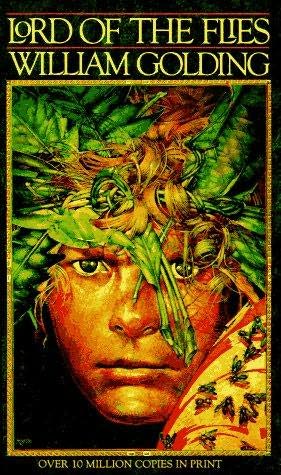
This story reminded me of Lord of the Flies. I think it's all that primitivistic stuff - the rituals and brutality of people.
~ Shirley Jackson, The Lottery
Talk about a surprise ending. Being stoned to death was the last thing I was expecting to be the "prize" of the lottery. This story actually raised more questions than it answered for me though - why did someone have to be killed every year? Why stone them? When was the tradition established? Why was the tradition established? How are things "not as they used to be?" I don't know. I'm just really intrigued right now.
 So this story focuses on point of view. It is in third person, so we see the actions of all the village people. I think this helps the story because it gives different perspectives and opinions of the ritual. Mr. Summers thinks it's necessary, Warner thinks it's evolved into something different, worse than it used to be, and Mrs. Hutchinson thinks that it is unjust and brutal (whether that is because she is morally sound or the victim, I am not sure).
This story reminded me of Lord of the Flies. I think it's all that primitivistic stuff - the rituals and brutality of people.
Subscribe to:
Posts (Atom)